

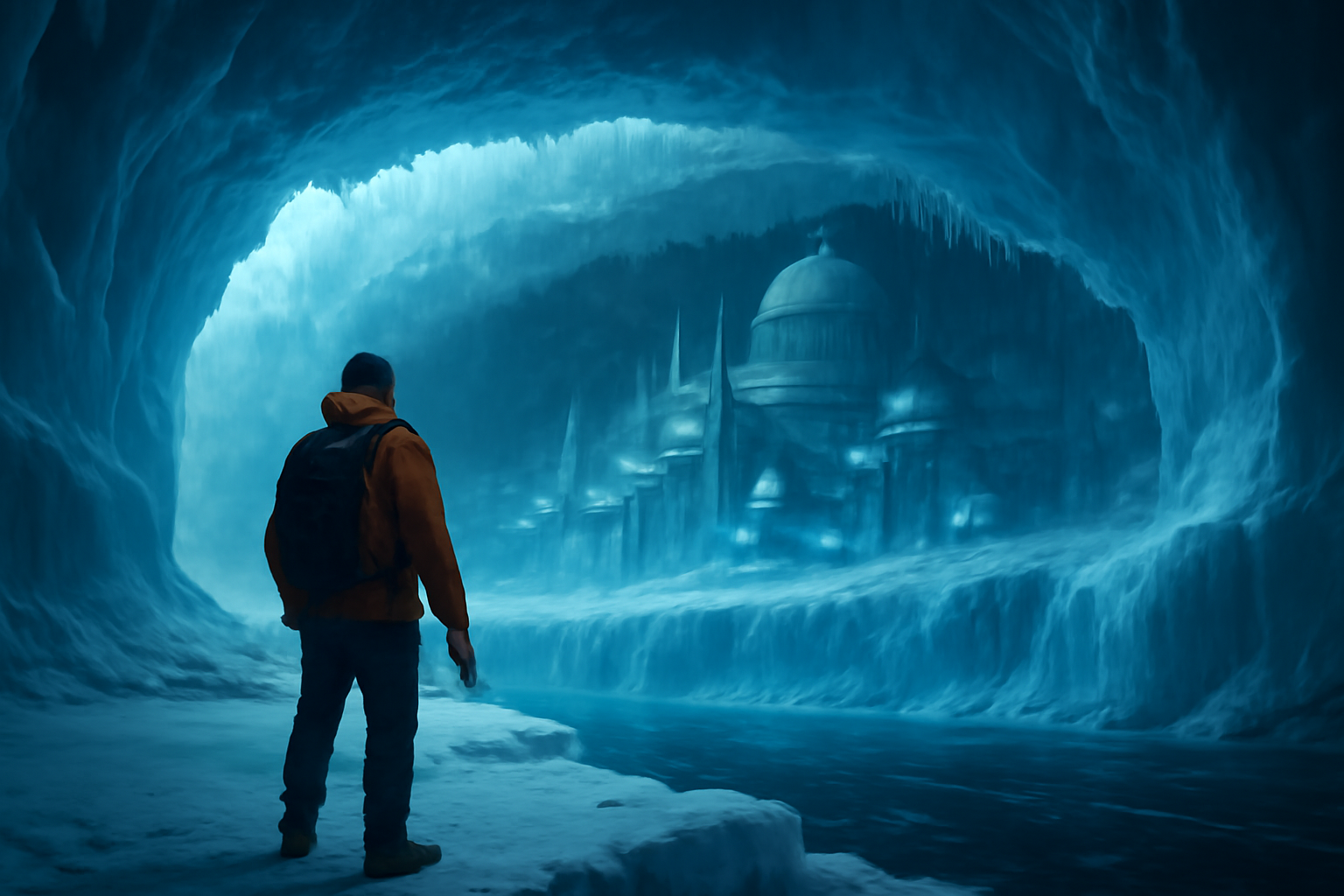
The drilling platform groaned under the weight of the storm, a low metallic shudder that vibrated through the soles of Dr. Lira Jensen’s boots. She tightened her hood against the slicing wind and trudged toward the edge, where the newest core sample lay steaming in the polar air.
It shouldn’t have been warm.
Nothing extracted from the Greenland ice shelf should ever be warm.
She crouched beside the cylindrical container, breath fogging in tight bursts. The ice inside was clear—not cloudy, not layered with sediment, but crystal-glass transparent. Suspended in the center were thin black lines—sharp, straight, geometric.
Nothing about it looked natural.
Tomás, her lead geochemist, jogged up behind her, clutching a printout. “You’re going to want to see this.”
“Tell me it’s contamination,” Lira said, even as she knew it wasn’t.
“Wish I could.” He flipped the page around. “The thermal signature in the lower strata—this isn’t geothermal. Something down there is emitting stable, patterned heat.”
“Patterned?”
“Yeah. Repeating intervals. Almost like…it’s alive.” He swallowed. “Or running.”
Lira looked back at the ice core. The black lines inside connected at perfect ninety-degree angles. A rectangle. A corridor.
A structure.
Her heart thumped in her chest. “No one publishes a word of this until we confirm.”
Tomás raised a brow. “Confirm what, exactly? That there’s a building two kilometers beneath the ice?”
“A building,” she corrected, “doesn’t hum.”
The report from yesterday’s seismic team still weighed on her mind: vibrations that didn’t match tectonic activity. Too smooth. Too deliberate. And now this.
Something ancient slept below their boots.
And for reasons they did not understand, it was warming up.
The descent capsule shuddered as the cable lowered them through the borehole. Blue-white ice blurred past the porthole like a vertical glacier, layered by centuries.
“Depth check,” Lira called.
“Eight hundred meters,” Tomás replied, fingers dancing over the console. “Heat signature increasing.”
Lira smoothed a hand across the reinforced window. The thermal sensor outside glowed with rising numbers.
Nine hundred meters.
One thousand.
Twelve hundred.
The hum began gently, a faint vibration in the rigging. Lira sat straighter. The hum grew stronger, more resonant than mechanical, like standing beside the bass note of an enormous cello.
Tomás stiffened. “That’s not the cable. It’s coming from below.”
“I know.”
The glacier walls transitioned from classic glacial blue to something…whiter. Purified. Then almost glass-smooth.
“That’s not ice,” Tomás whispered, leaning close. “It’s been melted and refrozen. Deliberately.”
At fifteen hundred meters, the capsule jolted as the borehole widened into an enormous cavern. Lira hit the floodlights.
Both scientists froze.
Below them, carved into the ice like an insect preserved in amber, was a city.
Towers of polished alloy rose at impossible angles, their surfaces unblemished by time. Bridges arched between them in graceful parabolas. Light—faint, but definite—pulsed from seams in the metal.
“God,” Tomás breathed. “It’s not a natural cavern. This entire chamber…someone excavated it.”
Lira stared, heart pounding. The structures weren’t broken. They weren’t crushed. They weren’t ancient ruins.
They were intact.
Preserved.
Waiting.
Mostly buried in ice, but glowing with low, rhythmic energy.
Atlantis.
Not drowned—frozen.
The capsule touched the ice platform with a muffled thud. Lira unlatched the hatch, the cold slamming into her lungs as she stepped out. The air was eerily still, as if the cavern itself held its breath.
She approached the nearest tower.
The metal was seamless, warm to the touch.
Warm.
A low pulse traveled up her fingers, like static in slow motion. Her breath caught. Tomás knelt beside her, examining the surface.
“It’s not oxidized. Not even scratched. Whatever this alloy is…it resisted time.”
A faint crack echoed across the cavern.
Both scientists turned.
A seam in the ice above the far end of the city glowed faintly. Then, with a sound like distant thunder, a section of the ice roof reshaped—just subtly, like warming glass. Frost fell in drifting spirals.
“The heat signature’s spiking,” Tomás warned. “Lira, this city isn’t just warm—it’s warming up.”
Not good.
Not remotely good.
She moved toward the central plaza, where a circular dais sat half-buried in ice. It looked like a control platform—six spokes radiating outward, each marked with glowing lines beneath the ice.
“How old do you think this place is?” Tomás whispered.
Lira shook her head. “Ice in this layer is one hundred thousand years old.”
“So the city—”
“Predates us,” she said. “By a lot.”
A sudden tone—pure and chimelike—rang through the cavern, vibrating the ice under their boots. Lira stumbled.
“What the hell was that?”
Tomás stared at his scanner. “There’s an EM burst. High frequency. Like something turning on.”
The dais flickered. A web of light pulsed beneath the ice, illuminating the lines in sudden brilliant blue.
Lira stepped back instinctively.
The ice over the control platform fractured.
With a sharp crack, the entire sheet shattered—falling away in crystalline shards to reveal the dais fully exposed beneath.
Tomás swore, stumbling backward.
Lira stared, breath freezing in her throat.
The symbols etched into the metal glowed brighter. Lines raced outward like veins awakening.
“Tomás,” she whispered, “this city is powering up.”
“But why now?”
Lira’s mind raced. “Our drilling. Our heat. We triggered something.”
Another tone rang—lower, resonant. The cavern trembled.
Lights flickered across every tower, running in synchronized patterns. The hum deepened into a layered chord, almost musical, almost intentional.
Like a greeting.
Or a warning.
“Lira—something’s moving under the ice!” Tomás shouted.
She spun. His scanner showed shapes—multiple—warming rapidly beneath the frozen streets.
“Nothing biological survives one hundred thousand years—”
“Unless it wasn’t biological,” Tomás snapped.
A section of ice ruptured near the edge of the plaza. A piece the size of a car flipped upward, scattering shards. Lira shielded her face.
Shapes rose.
Tall.
Sleek.
Built of the same alloy as the towers.
Machines.
Sentinels.
Dormant for millennia and now waking.
Their eyes—if those soft, glowing apertures counted as eyes—lit with the same blue as the dais.
Tomás whispered, “Lira. They’re scanning us.”
A beam swept over Lira’s chest. Her equipment hissed, every device glitching simultaneously.
“No sudden moves,” she murmured.
One of the sentinels stepped forward. Its movements were too smooth for machinery. Too fluid.
It paused only a meter from her.
The air shimmered between them.
A projection flickered to life above its hand—an image. A star map. The Earth. Lines branching outward to nine other points.
A network.
A civilization.
“Tomás…” Her voice cracked. “This wasn’t a city. It was an outpost.”
“An outpost of what?”
She didn’t answer.
The sentinel tilted its head, studying her. A second projection formed—numbers, sequences, pulses.
A countdown.
Lira’s stomach dropped. “I don’t think the city is waking up,” she whispered. “I think it’s reactivating. Preparing for something.”
The countdown ticked toward zero.
The cavern trembled once more—not from the city, but from above. The ice cracked under new stress. The roof was failing, destabilized by the heat.
“Lira, we need to go—now!” Tomás shouted, grabbing her arm.
The sentinel watched but didn’t interfere. Its projection shifted—showing a wave of energy propagating across the Earth.
A warning.
Or a request.
Or a promise.
The countdown hit zero.
Every tower flared simultaneously in a blinding flash of light.
And then—
Darkness.
The cavern fell silent.
The lights died.
The hum ceased.
The sentinels froze mid-motion, powered down.
Tomás gasped. “The whole city just…shut itself off.”
No.
Not off.
Reset.
Lira stared at the dais. The symbols were still faintly glowing. The countdown numbers looped back to their beginning.
A cycle.
A clock.
A message they had arrived too late—or too early—to understand.
She swallowed hard. “We need to surface. Immediately. The world needs to see this.”
Tomás nodded shakily.
But as they climbed back into the capsule, neither of them noticed the smallest detail:
One sentinel’s eye remained lit.
Dim.
Patient.
Watching.
Waiting for the next countdown.